

Mr. Needles
On Robbie Robertson's guitar playing

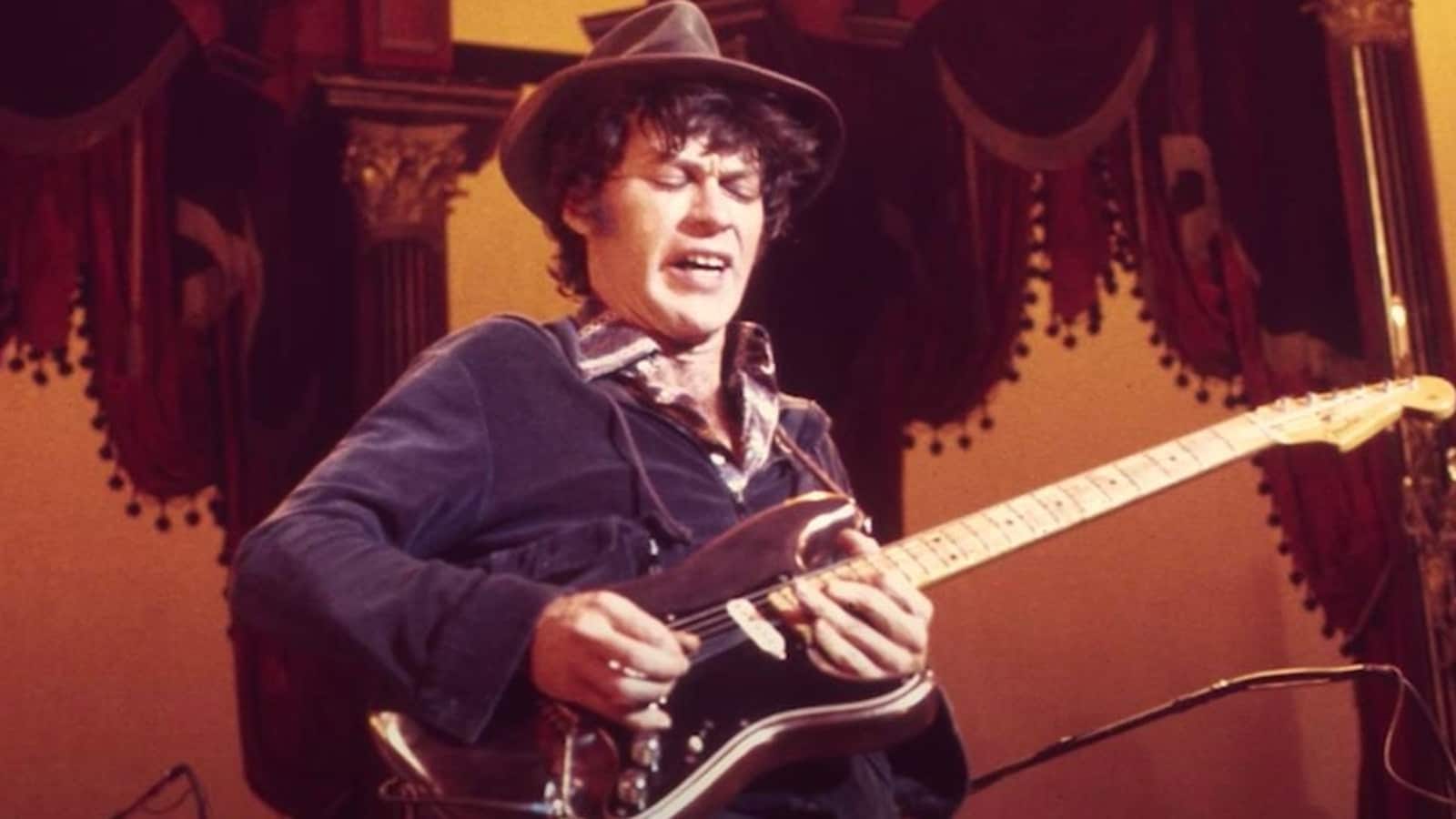
The most enduring image of Robbie Robertson is from the Scorsese’s The Last Waltz : strutting, grinning, sweating, most likely coked up, scarf around his neck and bronze-dipped Stratocaster in hand. Infamously, Marty’s camera loves Robbie. Of the five members of The Band, somehow he’s always the one in the shot, shredding and belting out backing vocals—backing vocals that ended up so buried in the mix that many wondered if his mic was simply off.
In the wake of his death, I’ve come to think there were really two Robbies, at least at the level of mythological type. There was this flamboyant Robbie, but there was also Robbie the craftsman, an exacting bandleader and the quintessential Americana songwriter. While the first Robbie’s chief sin was plain excess, the second’s was an excess of control—of the band’s image, of the royalty split, etc. Many of the tributes to him have focused on this more sober persona. And understandably so: this is the Robbie, after all, who gave us “The Weight” and “King Harvest.” He himself would set aside childish things and largely give up the barn-burning guitar playing. By his account, he made a conscious decision on the first Band record to channel the laid-back comping styles of players like Curtis Mayfield and Steve Cropper rather than blaze through every song. But I think the strutting, guitar-slinging Robbie deserves more credit than even he was willing to give himself.
Robbie’s guitar playing was about attack. Even in his more restrained moods—see the opening acoustic figure to “The Weight”—he slices the pick into the strings, giving the impression that each note is being ripped from the instrument rather than coaxed out of it. This ferocious attack gave his quieter playing a quality of shadowed danger. It made his more uninhibited playing sound positively explosive. In the recordings of the Band’s 1966 shows with Dylan, his stinging lines wrap around Bob’s vocals, bursting with a coiled impatience, until the time finally comes for a solo. Then, in his exuberance, it’s almost as if he doesn’t know what to do with himself. On the Manchester Free Trade Hall version of “Leopard-Skin Pill-Box Hat,” he unleashes a flurry of stuttering notes, uneasily punctuated by the drone of an open string. He’s behind the beat, or ahead of it. The chord changes; he’s too busy violently bending the strings to follow. It’s perfect. The song is a sneer; Robbie’s solo is an elbow to the jaw.
Robbie belonged to a generation that looked to the electric guitar as a totemic promise of more: more feeling, more danger, more volume. His peers recall him showing them how to outfit their instruments with thinner banjo strings, which allowed for the string-bending techniques that defined electric blues and early rock and roll. Even as other players caught up and the arms race for technique accelerated in the late ‘60s, Robbie continued to find subtle ways to wring new sounds out of the guitar. The first sound you hear on The Band’s Music from Big Pink is a queasy ascending figure from Robbie. The notes are pretty, but the tone is pulsing and murky. His guitar is running through a rotating speaker cabinet, the kind that usually pairs with a Hammond organ. It’s an effect that others were using at the time—most notably George Harrison on some of the Beatles’ later recordings. But while in George’s hands the Leslie cabinet sounded plush and rich, in Robbie’s it sounded volatile, oscillating between organic and alien. It was simultaneously a human voice and the voice of a machine.
Later in his career, Robbie would develop another trick for extending the guitar’s vocabulary. More and more, he would accent his bent notes not just with his fast and narrow vibrato, but with a metallic squealing noise: a pinch harmonic, produced by brushing the thumb over the string immediately after picking it, causing a higher tone to sound. This technique is now usually associated with shredders—Zakk Wylde being a notorious abuser of the pinch harmonic. But Robbie got there first, and in a very different musical context. In his songs, the clangs and squeals condense the core drama of his playing into one explosive point: fits of abandon that produce the occasional moment of soaring transcendence.
But if Robbie’s playing was a trancelike abandon, it was an abandon that took real effort. That effort registered on his face and in his body—in footage, he grimaces as he jerks the guitar around, wrenching the notes out of it. It also registers in the playing itself, which often has a headstrong, stop-start quality. There’s no better demonstration of this than the version of “Further on up the Road” from The Last Waltz, where Robbie and Eric Clapton enter into what Robertson later called a guitar “dialogue.” Clapton starts off the mid-tempo blues shuffle with a fluent solo composed of stock Claptonisms. But then his strap detaches from his guitar, seemingly coincidentally at the moment where the band cuts out at the turnaround. Immediately, Robbie picks right up with a solo that has been burned into my brain since I first heard it when I was 11 or so. Where Clapton’s break is controlled, Robbie’s is coming off the rails from the opening notes. A repeating figure gives way to a beautiful sustained bent note—and then we descend into the murk again with a clanging low-string line that gathers energy like a chainsaw shuddering to life. They trade more breaks as the song goes on. Clapton goes into rawer territory; Robbie answers with a flurry of open-string drones and choked-out double-stop bends. In his final break, Clapton finally seems to wake up, weaving together a version of Robbie’s screeching bend style with his own bouncing staccato figures. It wasn’t a competition. But Robbie’s playing hits me in a way that Clapton’s never has.
Clapton makes it look easy; Robbie makes it look like you have to drain every ounce of your life force in order to get there. Some count this against Robbie. But I’ve come to think sprezzatura is an overly prized quality in music. There is pleasure in seeing a calm and breezy performance of mastery. But it is far from the only pleasure. There is also the thrill of watching someone approach playing as a strenuous, out-on-a-ledge exertion, reaching for notes that may or may not be there, breaking the instrument in an effort to expand its basic set of capacities. If Clapton was at one point a genius, Robbie was something more remarkable: in the words of—please allow me this indulgence—one Naruto character, he was a genius of effort. The performance of effort, the sweat and furious motion, is part of the genius.
In fact, the drama of Robbie’s guitar playing is the drama of his musical idiom itself—roots rock, Americana, whatever you want to call it. It is the confrontation between straining human life and rationalized technology, between folk culture—or the reified idea of folk culture—and mass reproducibility, between passing down tradition and broadcasting it, between the intimate pressure of the unamplified voice and the impersonal crush of going electric. Robbie’s strain both results from and channels this tension. The strain isn’t authenticity—though that’s an easy mistake to make; today’s most conservative roots artists relish in stylized hiccups and squeals meant to signal that their music is an authentic emanation from “real” people. (The squeal is in this way a literal dog whistle to white nationalists and their billionaire backers.) Just the opposite: the strain is a recognition on a formal level that any appeal to authenticity is a reactionary back-formation, a form of mythological wishful thinking. It’s no coincidence that so many Band songs are about characters history seems to have left behind. Robbie’s guitar sounds the Miltonic theme: in the words of Dave Rawlings and Gillian Welch, “pilgrim, you can’t go home.” Rather than bemoaning this fallen condition and retreating to the right-wing nostalgia that abounds in much contemporary roots music, Robbie did the sweatiest, most effortful thing you could possibly do: he made art out of it.
Perfectly articulated. I remember my uncle showing me that Last Waltz ‘dialogue’ between Robertson + Clapton when I was 14 and asking who I liked better. I chose Robbie even though at that time I couldn’t articulate why.
So many of his distinctive guitar parts are instilled in my memory, those pinched notes on the intro to Going, Going, Gone on Planet Waves to name just one…
Truly unique and somewhat understated player.
Great piece.